Westland Wessex
Westland Wessex
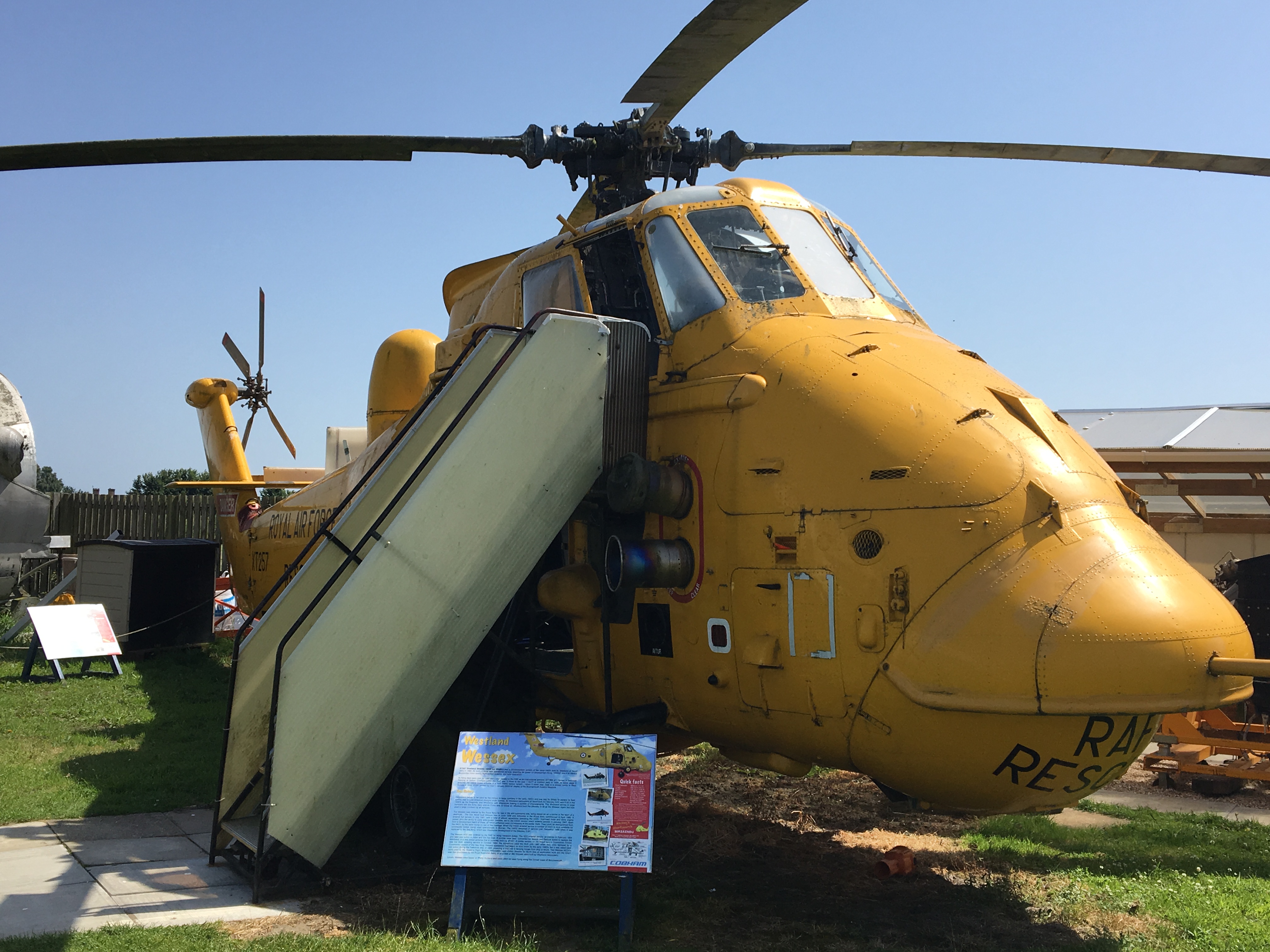
Our Aircraft
XT257 Westland Wessex HAS3 (cn WA241) was a pre-production version of the naval HAS3 built by Westland at Yeovil early in 1965. As such, it never saw operational service, spending its career on development flying. 1966/67 saw it at A&AEE Boscombe Down testing flight control systems and radio evaluation.
Its flying days were over by 1980 and it was passed to the RAF as an instructional airframe (8719M) at 1 School of Technical Training at Halton. Changes within the RAF saw it move to the new 1 SoTT at Cosford early in 1995. At some stage it acquired the yellow colour scheme of a RAF HAR2 rescue variant – which it never was. Sold to a private owner in West Sussex in 1998, XT257 arrived by road in January 2005 for display at the Bournemouth Aviation Museum.
Type History
Helicopters began to be used by the military in large numbers in the early 1950’s and one way for Britain to expand its fleet quickly was to build American designs under license. So Westland Helicopters of Yeovil built the Sikorsky S-51 and S-55 in the 1950’s as the Dragonfly and Whirlwind, with Westlands making a number of improvements. The Whirlwind served in large numbers with the Army, Navy and Air Force and, to follow on, Westland built the Sikorsky S-58 as the Wessex. Again this was used in large numbers by all services.
The Wessex was ordered by the Royal Navy for use in the anti-submarine role, being based on an a carrier or the stern of a destroyer. The first Yeovil built Wessex flew in June 1958 and deliveries to the Royal Navy commenced in April 1960. It entered full service in July 1961, with a total of eleven squadrons operating the HAS1. Improved radar and extra engine power, plus the ability to carry wire-guided missiles, led to the HAS3 version which entered service in January 1967. Apart from a development batch of three, all HAS3 airframes were conversions of the earlier mark. They could be distinguished from the HAS1 by the radar hump on top of the fuselage. When the HAS3 entered service a number of HAS1’s were available for commando duties, being used operationally in Borneo. The HAS3 remained in service until December 1982 when it was replaced by the Sea King, which was Westlands development of the Sikorsky S-61.
The Wessex HC2 was ordered by the RAF for troop transport duties. The HC2 entered service at Odiham in February 1964 and later saw action in Aden and the Far East. A number were later converted for Search and Rescue duties to replace the Whirlwind. It is this colour scheme that is currently worn by XT257. A similar version for the Royal Navy’s Commando Forces was the HU5, entering service in October 1964. Six squadrons used the HU5 until 1987 when they were replaced by a Commando version of the Sea King. Wessex operations had begun to wind down by the early 1980’s, but it was called back into action during the Falklands War of 1982, providing a vital role in ferrying troops from ship to shore. Two Wessex HCC4’s were used by the Queen’s Flight. Bristow Helicopters used civilian Wessex for North Sea oil exploration work and the HAS1 was also purchased by the Royal Australian Navy. In all a total of 382 Wessex were built by Westland Helicopters.
Locally Wessex were based at RNAS Portland and could often be seen flying along the Dorset coast off Bournemouth.
Technical Data
Length: 65 ft 10 in / 20.7 m
Height: 15 ft 10 in / 4.83 m
Rotor Diameter: 56 ft 0 in / 17.7 m
Service Ceiling: 12,000 ft / 3,660 m
Max Speed: 106 kts / 122 mph
Max Weight: 13,500 lb / 6,123 kg
Seating Capacity: 2 Crew, 16 troops
Engines: 2 x Bristol Siddley Gnome H.1200 Mk 110/111 turboshaft