English Electric Canberra PR.7
English Electric Canberra PR.7
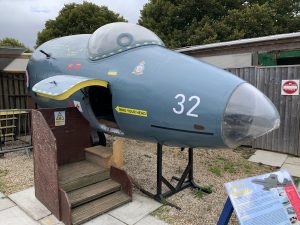
Our Aircraft
WT532 English Electric Canberra PR.7 (cn 71449) was built in the summer of 1955, being delivered to RAF Germany in October for use by 80 Squadron. It also served with 17 Sqd in Germany, before being transferred to 13 Sqd in Malta in the late 1960’s. However it returned to Germany again where it served with 13 Sqd at Laarbruch. It only served a few months before being transferred to 58 Sqd back home at Wyton. When the squadron disbanded in 1970 WT532 continued to serve with the Station Flight.
Retired from active service by 1981, the aircraft was allocated for use as a ground instructional airframe. However it was reprieved and flown to RAE Bedford in February 1982 where it continued to fly on trials duties until February 1985. After a period of storage it moved to 2 School of Technical Training at Cosford in April 1986 for ground instruction duties. No longer required, it was put up for sale in the autumn of 1991 and purchased by Lovaux for spares recovery.
It was moved to their site at Bournemouth Airport in April 1992 and, when no longer of further use, passed to the Airport Fire Section in June 1994. However after little use the fuselage was donated to the Bournemouth Aviation Museum in July 1999. In the event it was agreed by the Museum volunteers just to restore the cockpit section which you now see on display.
Type History
The Canberra was a very successful British bomber originally designed in the mid 1940’s and proving a quantum leap over the propeller driven Lincoln. The prototype flew on Friday 13 May 1949 and it was ordered in large numbers by the RAF where its two main roles were as a high altitude light bomber and a photo reconnaissance platform. The bomber could carry 6,000lb of bombs in its bomb bay and entered service with 101 Squadron at Binbrook in May 1951. The PR version could carry a variety of high definition cameras in a special compartment in the front of the bomb bay area, entering service with 540 Squadron at Benson in December 1952. By then hundreds of Canberras were on order and they served with over forty RAF squadrons during the 1950’s. As English Electric were unable to produce all the Canberras on order, arrangements were made for production also to be undertaken by Avro, Handley Page and Short Bros. English Electric were delighted when the Canberra was ordered by the USAF as the Americans had no similar ‘home grown’ bomber. The first of many orders was placed in March 1951 with the aircraft being produced by Martin Aircraft at Maryland. Australia also built the Canberra, although in smaller numbers. The USAF and Australian aircraft saw action in the Vietnam War.
As well as serving at home, RAF Canberras were based in Germany, the Middle and Far East. Here they saw action during the Malaysian Emergency of the 1950’s. Back home improvements were made leading to the B(I)8 low level interdictor bomber version and the PR.9 capable of reaching over 60,000ft. The early bomber versions were taken out of service by the early 1970’s, but the B(I)8 continued in used by RAF Germany for a few more years. The PR.9 remained in service until July 2006, having seen active service over Iraq and Afghanistan. This means the Canberra served the RAF for fifty five years.
In addition to Australia, Canberras served with a number of ‘Commonwealth’ countries such as India, Rhodesia, South Africa and New Zealand. It was also operated by a large number of overseas air forces ranging from Argentina to Sweden, including Chile, Ethiopia and Venezuela. It fell to India to operate the last Canberras, the final one in May 2007.
In later years Canberras served in a variety of second line roles, including Electronic Counter Measures (ECM) trainers, target tugs, unmanned drones, engine test beds and ejector seat trials. One such use saw Canberras based at Bournemouth from September 1969. These were target tugs operated by Airwork Services on behalf of the Royal Navy. Sleeve targets were towed behind the aircraft on a very long wire for Royal Navy gunners to practise their skills.
Technical Data
Length: 65 ft 6 in / 19.96 m
Height: 15 ft 8 in / 4.77 m
Wing Span: 64 ft 0 in / 19.51 m
Service Ceiling: 48,000 ft / 14,545 m
Max Speed: 580 kts / 667 mph
Max Weight: 55,000 lb / 24,948 kg
Seating Capacity: 2 Crew
Engines: 2 × Rolls-Royce Avon R.A.7 Mk.109