Hawker Hunter T8 – WT722
Hawker Hunter T8 – WT722
Our Aircraft
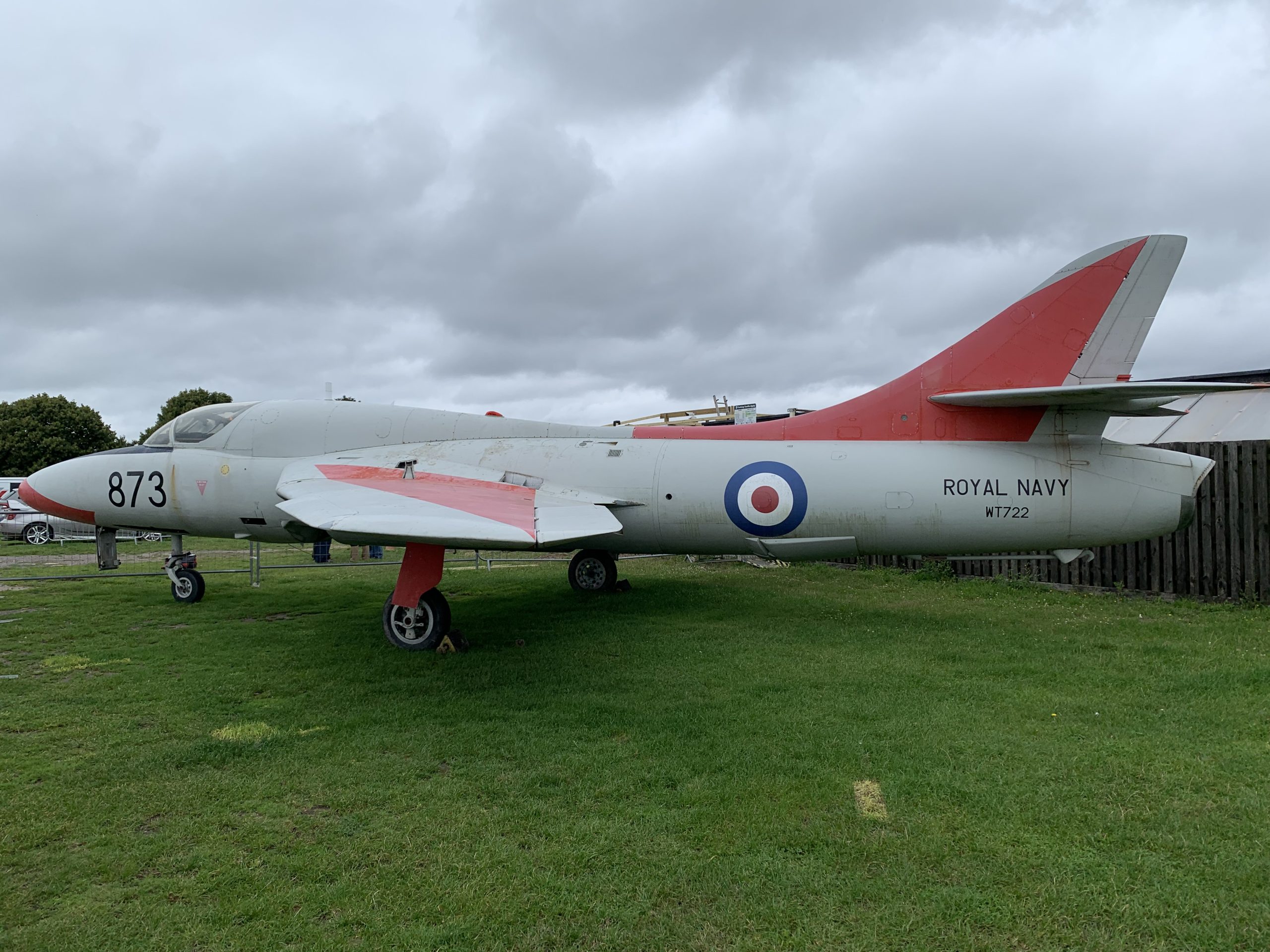
Hawker Hunter T8 WT722 (cn 41H-670689) was originally built at Dunsfold as a Hunter F4 for the RAF, being delivered on 4 February 1953. Initially it served with 54 Sqd, later with 26 Sqd. On withdrawal from RAF service WT722 was converted to a two seat Hunter T8 and delivered by Hawker Siddeley to the Royal Navy in July 1959. Operated by 764 Sqd at Lossiemouth from March 1960, it transferred to 759 Sqd at Brawdy in June 1967. Moved to the Airwork FRADU at Yeovilton July 1970, WT722 was withdrawn from service in December 1994. Purchased by Classic Jets at Exeter and placed on the civil register as G-BWGN in August 1995. Limited flying was undertaken during the next three years, following which it passed through various owners, being based at Exeter and Coventry. By the spring of 2011 it was decided to ground WT722 as a museum exhibit. Moved to Newquay with the Cornwall Aviation Museum, the Hunter had to moved when the it closed in 2023. It was acquired by the Bournemouth Aviation Museum, arriving in August 2023.
Type History
The Hunter was a successful British jet fighter of the 1950/60s being sold by Hawker Siddeley around the world. Armed with four 30mm Aden guns, the Hunter entered RAF service in July 1954 operating at home, in West Germany and the Middle & Far East. A trainer version was also developed, with deliveries to the RAF made from the spring of 1958. Designated as the Hunter T7, these were fitted with just one Aden gun. At the same time Hunter Trainers were also acquired by the Royal Navy for use by their training squadron.
The Navy aircraft - Hunter T8s - were fitted with an arrester hook under the rear fuselage. This was just for training at Naval airfields – the Hunter was not used on aircraft carriers. With successful overseas sales of the fighter version, the majority of overseas air forces also acquired the trainer version. Many of these were converted from surplus Hunter fighters, having a new nose and cockpit section fitted.
The RAF mainly used their Hunter T7s for weapon training for pilots progressing to front line fighters. Training was carried out by 229 Operational Conversion Unit, with front line fighter squadrons also having a T7 on strength. RAF Hunter Trainers remained in services until March 1994 when they were replaced by Hawks. The Royal Navy used its T8s for training pilots who would progress to Scimitars and Sea Vixens. The Royal Navy continued using them until April 1995 when they were again replaced by Hawks. The Indian Air Force was the last major user of the Hunter, with its frontline aircraft withdrawn in 1996. However some of their trainers continued flying for a while longer.
On completion of military service a number of Hunters were acquired by private individuals and companies for display at air shows. Prominent among these was Jet Heritage here at Bournemouth Airport in the 1980s, overhauling both fighter and trainer versions. Some of these were supplied to the Royal Jordanian Air Force Historic Flight in the 1990s. A number of companies still operate a few Hunters in the aggressor training role in the 2020s – these can be found in Canada, the USA and the UK.
Technical Data
Length: 48 ft 10 in / 14.9 m
Wing Span: 33 ft 8 in / 10.26 m
Service Ceiling: 50,000 ft / 15,240 m
Max Speed: Mach 0.94
Max Weight: 24,600 lb / 11.158 kg
Seating Capacity: 2 Crew
Engines: 1 x 7,425 lb thrust Rolls-Royce Avon 122