Gloster Meteor
Gloster Meteor
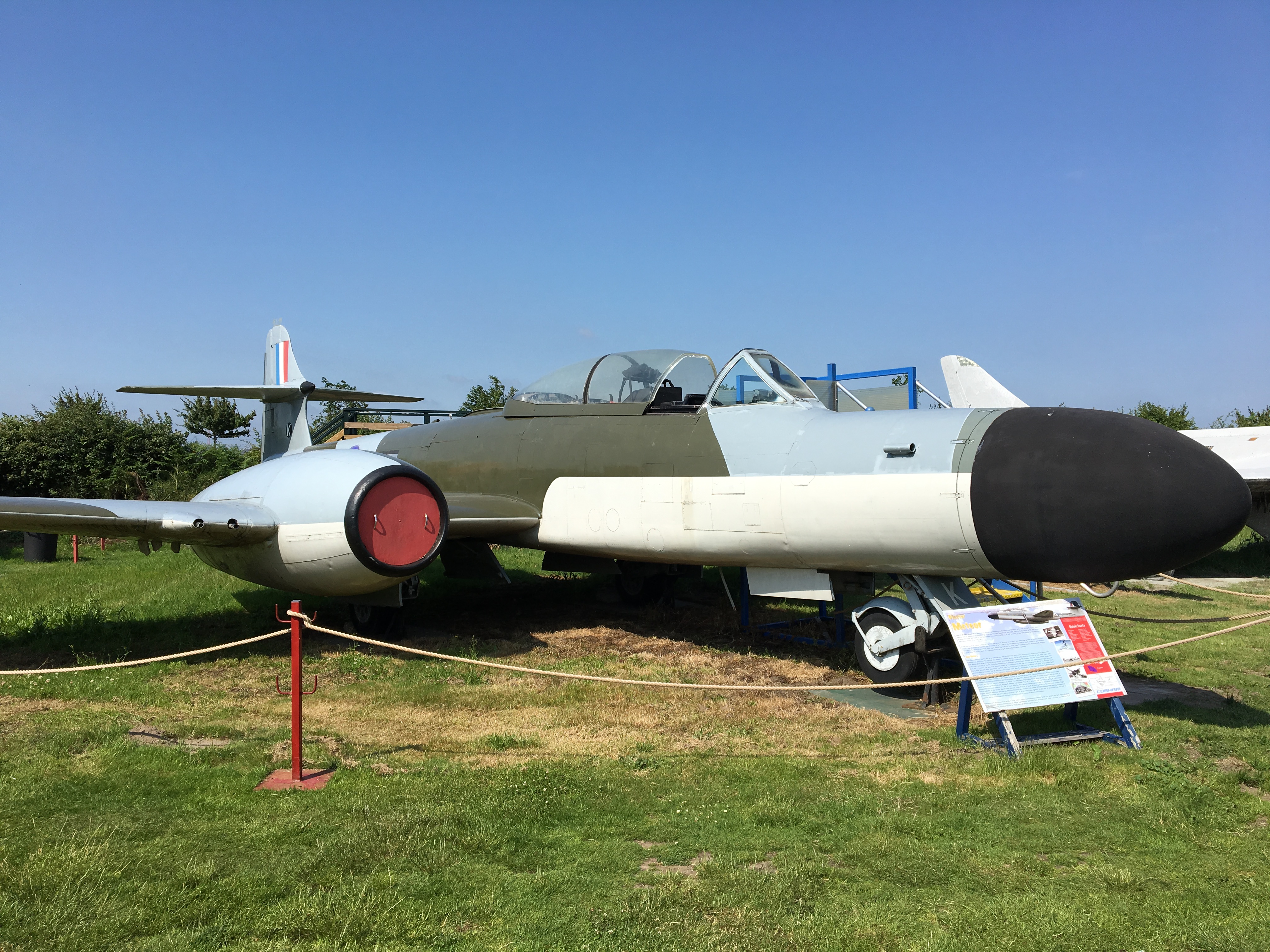
Our Aircraft
WS776 Gloster Meteor NF14 was built by Armstrong Whitworth at Coventry and delivered to the RAF on 22 February 1954, serving with 25 Squadron at West Malling. It transferred to 85 Squadron in July 1958, then to 72 Squadron at Church Fenton in November 1958 and finally to 228 Operational Conversion Unit (OCU) at RAF Leeming in July 1960 before being withdrawn from active service in January 1961.
It was then used for a short period as a ground maintenance airframe (as 7716M), later being transported to North Luffenham where it was displayed by the main gate. Disposed of by the RAF in March 1998 it was taken to North Coates for preservation. It moved to Sandtoft in November 1999, again being displayed by the main gate. Purchased by the Bournemouth Aviation Museum, WS776 moved south on 5 February 2005, carrying its original 25 Squadron markings.
Type History
The Gloster Meteor was the first jet to enter service with the RAF. First flight of this revolutionary fighter was on 5 March 1942. Ordered into production for the RAF, the Meteor F1 entered service with 616 Squadron at Manston in July 1944. Here their task was to shoot down V1 flying bombs as they crossed the English Channel. These early F1s had a very limited range and were soon replaced by the F4. The initial Meteors were powered by Rolls-Royce Welland jets, being replaced by Derwents from the F4 version. The type soon became known as the ‘Meatbox’ in RAF service. Following the end of the Second World War further Meteors were ordered for the RAF, with the much improved F8 entering service in August 1949. These fighter versions were armed with four 20 mm cannons in their nose, with the F8 capable of 550 mph at 30,000 ft. Meteors were ordered by many overseas air forces – including Argentina, Australia, Belgium, Brazil, Denmark, Holland, Egypt and Israel.
The RAF had an urgent need for a night fighter to replace its wartime Mosquitoes. Development of this Meteor version was undertaken by Armstrong Whitworth, with the prototype two seat NF11 flying in May 1950. This was equipped with AI radar in its nose, with the four cannons moved to its wings. As they were responsible for its development, the night fighter version became known as the Armstrong Whitworth Meteor, not Gloster. The NF11 entered RAF service in spring of 1951, being followed by improved versions. The last of these was the NF14 which entered service with 25 Squadron in February 1954, being replaced by the Gloster Javelin from January 1956. The NF14 could be distinguished by its clear view cockpit. Night fighter Meteors were also operated by Belgium, Denmark and France. In all a total of 3.545 Meteors were built by Gloster and Armstrong Whitworth between 1942 and 1955 – 575 of which were night fighters. At the end of production just 100 NF14 variants had been manufactured and were the first aircraft to introduce cabin pressurisation.
Meteors were employed for a variety of other duties. Photo reconnaissance, trainer, target tug, engine test bed, flight refuelling trials, pilotless drone to mention some. Target tug Meteors operated from Bournemouth 1958 – 71 with the Airwork Fleet Requirement Unit, providing targets for Royal Navy shipborne trainee gunners.
Technical Data
Length: 51 ft 4 in / 15.5 m
Height: 13 ft 11 in / 4.2 m
Wing Span: 43 ft 0 in / 13.1 m
Service Ceiling: 40,000 ft / 12,192 m
Max Speed: 508 kts / 585 mph
Max Weight: 45,750 lb / 20,752 kg
Seating Capacity: 2 Crew
Engines: 2 x Rolls Royce Derwent 8