Handley Page Dart Herald
Handley Page Dart Herald
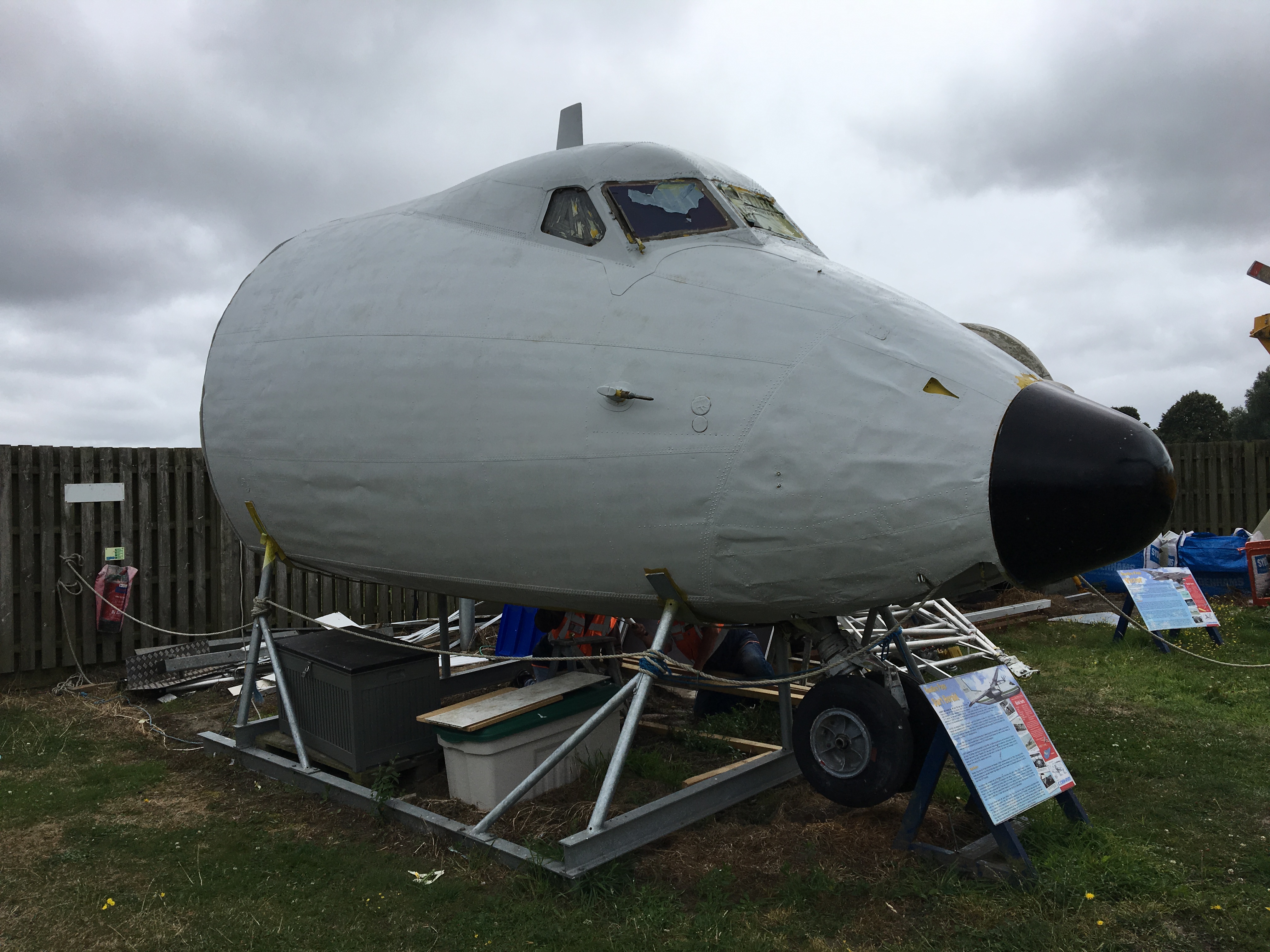
Our Aircraft
G-BEYF Dart Herald Srs. 401 (cn 175) was built by Handley Page at Radlett and flown on 3 January 1964. It was one of eight ordered by the Royal Malaysian Air Force being delivered with serial FM-1022 on 17 January. The fleet were based with 4 Sqd at Kuala Lumpur, being fitted to carry 50 troops, 24 stretchers or 10,000 lb of cargo. The Heralds served the Malaysians well, but there was a need for greater capacity. So in 1976 the C-130 Hercules was selected, resulting in the Heralds being sold the following year to British Air Ferries.
FM-1022 was reregistered G-BEYF and entered service from Southend in October 1977. Early in 1979 a number of BAFs Heralds were transferred to BIA, including G-BEYF, continuing to operate from Southend. BIA and Air Anglia merged to form Air UK, having a combined fleet of 20 Heralds. After a number of years service, G-BEYF was sold to Elan-Air in April 1986 and used in an all-cargo role. It operated to the continent, mainly delivering packages and parcels. The aircraft was suited to this role as, being ex-military, it had a strengthened floor.
In August 1988 G-BEYF was sold to join the expanding fleet of Channel Express at Bournemouth, operating on their services to the Channel Islands and Royal Mail flights to Liverpool. At one time Channel Express had a fleet of fourteen Heralds, but these were eventually replaced by L188 Electras and F27 Friendship freighters.
G-BEYF operated the world’s final Herald flight on 9 April 1999 – the nightly Royal Mail service from Bournemouth to Liverpool and return. On 26 May it was towed to the original Bournemouth Aviation Museum for preservation. Unfortunately, when the Museum was forced to close in December 2007, there was no place for the Herald and it was scrapped. However, perhaps having an eye on the future, the nose section was taken away in one large lump and saved. This was sought out by the Museum in the spring of 2015, seeing its return in June.
Type History
Handley Page was one of many companies who designed a Dakota replacement aircraft in the 1950s. Their original HPR.3 Herald was powered by four Alvis Leonides Major piston engines, with the prototype flying in August 1955. By the time the second prototype flew a year later Handley Page realised their new airliner needed to be powered by turbo-props, as was the rival Fokker F27 Friendship.
The prototype was re-engined with two Rolls-Royce Dart turbo-props, flying again in March 1958. In August it suffered an uncontrollable engine fire, being destroyed in the subsequent crash landing. The second prototype took to the air in December and Handley Page announced that it was building a batch of ten Heralds. To aid the company the Ministry of Supply ordered three in June 1959 for service with BEA. These were Srs100 aircraft, carrying 44 passengers. The first order from an airline came in September 1960 when Jersey Airlines ordered six of the Srs200 aircraft, carrying 48/50 passengers. The first of the batch of ten (G-APWA) flew in October 1959 and spent most of its life as a demonstrator.
The Herald entered service with Jersey Airlines in May 1961 on the route from Jersey to Bournemouth using leased aircraft until their own were available in May 1962. Faced with competition from the F27 Friendship, Herald sales were slow, usually being ordered in twos or threes from countries ranging from Canada, Italy, Brazil, and Israel. Production ended in the summer of 1968 with only 50 aircraft completed. Over the years there were many second-hand sales seeing operations in other parts of the world. Slowly the Herald disappeared, the final operator being Channel Express of Bournemouth. As with many airlines they replaced their Heralds with F27 Friendships, with the final service from Liverpool to Bournemouth taking place in April 1999. This resulted in Bournemouth Airport witnessing the first and last ever service of the Herald.
Technical Data
Length: 75 ft 6 in / 23.01 m
Height: 24 ft 0 in / 7.32 m
Wing Span: 94 ft 10 in / 28.90 m
Service Ceiling: 29,700 ft / 8,140 m
Max Speed: 235 kts / 275 mph
Max Weight: 43,700 b / 19,818 kg
Seating Capacity: 2 Crew
Engines: 2 x Rolls-Royce Dart Mk 527 Turboprops