Hawker Hunter F6
Hawker Hunter F6
Our Aircraft
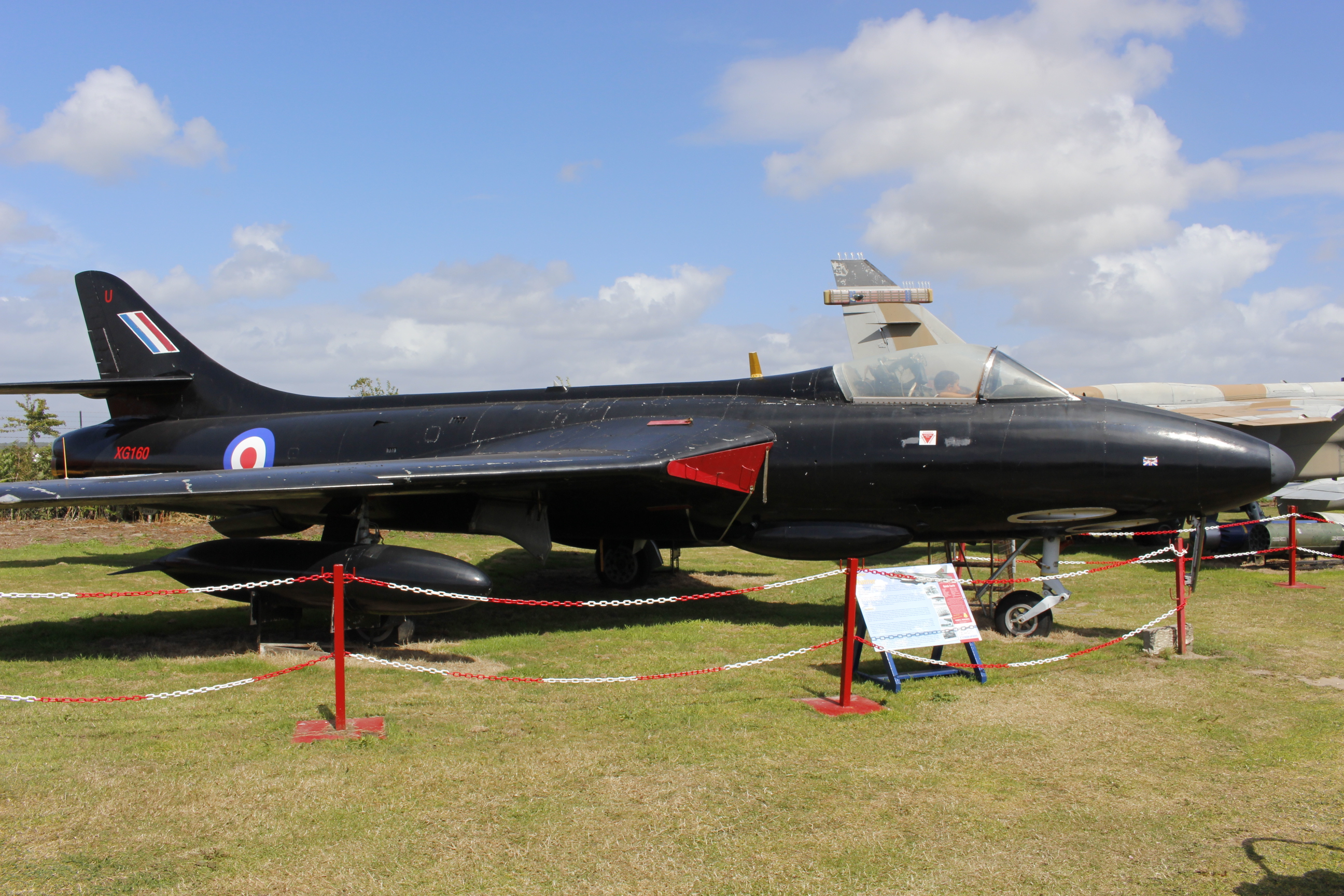
XG160 Hawker Hunter F6 (cn S4/U/41H/3393) was a standard Hunter F6 built by Armstrong Whitworth at Coventry and delivered to the RAF in August 1956. Initially it served with 43 Squadron at Leuchars before being transferred south to 111 Squadron at North Weald in 1958. At the time 111 Squadron was renowned as the RAFs premier aerobatic team – the Black Arrows – their Hunters being painted black overall. The team specialised in mass formation displays.
By the spring of 1966 XG160 was serving with 229 Operational Conversion Unit (OCU) at Chivenor before ending its flying days with No 1 Tactical Weapons Unit (TWU) at Brawdy in June 1982. It was transferred to Scampton as an instructional aircraft (8831M) with the Trade Management Training School (TMTS) in September 1984, who restored it to 111 Squadron colours. XG160 was sold in December 1994 and moved to Jet Heritage at Bournemouth, where it was allocated civil registration G-BWAF in February 1995 in anticipation of being restored to fly. However this did not happen and the Hunter passed into the hands of the Bournemouth Aviation Museum.
Type History
The Hunter was considered the most successful jet fighter built in Great Britain. Developed by Hawker Aircraft as a day fighter to replace the RAF’s Meteors and Venoms, it was powered by the new Rolls-Royce Avon of 7,500 lb thrust and armed with four 30mm guns in an under fuselage gun pack. At the same time a version with the Armstrong Siddeley Sapphire engine was also built. First flown in July 1951 both versions of the Hunter was ordered into super priority production for the RAF – this was the time of the Cold and Korean Wars. As well as Hawker, large numbers of Hunters were built by Armstrong Whitworth Aircraft – also part of the Hawker Siddeley Group.
The Hunter F1 & 2 entered service in July 1954 but soon showed that they were short on range. The improved F4 & 5 entered service in June 1955 having increased fuel capacity and underwing stores. The definitive F6 followed powered by a 10,000lb thrust Avon and able to carry a variety of underwing bombs and rocket projectiles. It entered service in May 1955, serving with a large number of RAF squadrons both at home and RAF Germany. Pilots described the Hunter as a real joy to fly. To replace Venoms in the ground attack role the Hunter FGA9 was developed, with large numbers converted from existing F6s. This new version served in RAF Germany as well as the Middle and Far East until 1968.
The Hunter proved a success in the export market. Commencing with Sweden in 1954, Hunters were ordered by air forces around the world, including Belgium, Holland, India & Switzerland. When the RAF’s Hunters were replaced by Lightnings their surplus aircraft were repurchased by Hawker and refurbished for export customers until 1975. The final Hunters to remain in front line service were those of the Indian Air Force who finally withdrew them in 2004. Just under 2,000 Hunters were built, but many of these were refurbished to an ‘as built’ standard. Enthusiasts recall the Hunter through two events in the 1950s. On 7 September 1953 Neville Duke broke the world speed record attaining 727.63 mph over the Sussex Coast. Then at the September 1958 Farnborough Air Show the RAF’s 111 Squadron Aerobatic Team looped a formation of twenty-two Hunters – a record that has never been beaten. XG160 was one of the aircraft in this formation.
Technical Data
Length: 45ft 11 in / 14.0m
Height: 13ft 2 in / 4.01m
Wing Span: 33ft 8 in / 10.26m
Service Ceiling: 50,000 ft / 15,240m
Max Speed: Mach 0.94
Max Weight: 24,600lb / 11,158 kg
Seating Capacity: 1 Crew
Engines: X 1 Rolls Royce Avon 207