Avro Vulcan
Avro Vulcan
Our Aircraft
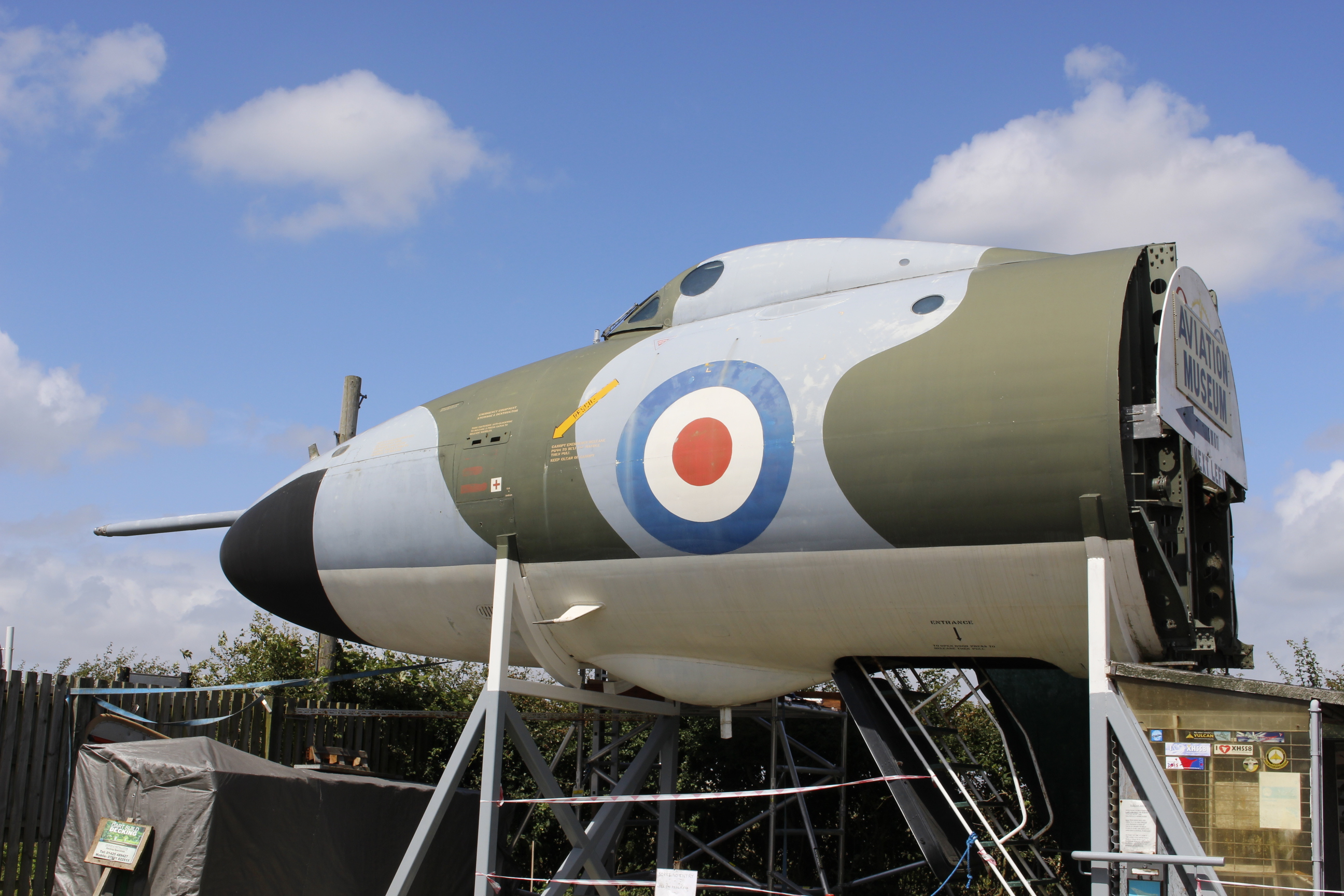
XH537 Vulcan B.2MRR was built in 1959 and delivered to the RAF in August. However it was set aside as a trials aircraft for the American Skybolt missile, being fitted with two dummy Skybolts under its wings by the summer of 1961. With the Skybolt programme cancelled XH537 then served with 230 Operational Conversion Unit (OCU) at Finningley. It saw operational service from 1978 with 27 Sqd. at Scampton as a MRR version undertaking maritime reconnaissance.
Withdrawn from service by early 1982 it was allocated for ground instruction use at Abingdon in March. It survived until May 1991 when the aircraft was broken up with the nose section being saved. This was stored at Camberley and Ottershaw before moving north to Bruntingthorpe where XH537 was put on display. The owner moved the nose to Bournemouth in October 1991, ownership passing to the Bournemouth Aviation Museum in March 2003.
Type History
The Vulcan was one of the three V-Bombers operated by the RAF during the 1950/60/70’s, the others being the Valiant and Victor. Thoughts on the Vulcan began in 1947 under Roy Chadwick who had designed the wartime Lancaster. The new bomber was required to carry a large bomb load long distances essentially into Russia during the Cold War. The revolutionary delta wing design took to the air in August 1952, by which time the RAF had already placed its first order. The delta wing shape was chosen to give a high subsonic speed at high altitude, a good bomb carrying capability and a long range. The unarmed bomber carried a crew of five and its bomb bay could hold twenty-one 1,000 lb bombs. At the 1955 Farnborough Airshow Avro’s test pilot drew gasps from the crowd when he rolled the delta bomber as ably as a fighter.
The Vulcan B1 entered service with the RAF in May 1956. These production aircraft were fitted with 12,000lb thrust Bristol Siddeley Olympus 102 engines, giving a speed of 625 mph and a range of 3,450 miles. After completion of forty-five aircraft, production switched to the B2 version which had a larger wing span and was powered by 17,000lb thrust Olympus 201’s. Nuclear bombs were carried and range was increased to 4,600 miles. The B2 entered operational service in October 1960. It was the intention to fit the Vulcan with the American Skybolt stand-off missile – one under each wing. This meant the bomber did not have to fly all the way to its target – it could release the missile to make its own way to Russia. Trials were undertaken from the summer of 1961 with a Vulcan carrying dummy Skybolts, the Americans cancelled the programme in December 1962. So the Blue Steel stand-off bomb was developed by Avro for the Vulcan, entering service in 1963 with bombers based at RAF Scampton. Now designated B2A, this version had a more powerful Olympus fitted to cope with the extra weight, but had a reduced range. Eleven RAF squadrons operated the Vulcan B2/2A.
In July 1969 the Royal Navy took over Britain’s nuclear deterrent with its fleet of Polaris equipped submarines. This saw the RAF Vulcans switch to a tactical bombing role, which was carried out at low level and resulted in the bombers receiving full camouflage. The Tornado was to replace the Vulcan in this role, but it did not enter service until early in 1982. So as the RAF began withdrawing their Vulcans, it found it needed them when the Falklands War erupted in April 1982. So after twenty-six years of service, without seeing action, the Vulcans swan song was finally to go to war. Operating from Ascension Islands in the mid-Atlantic, Vulcans set out in May to bomb Port Stanley – 4,000 miles away. This meant flying for fifteen hours and being refuelled numerous times by Victor tankers. Although the main runway at Port Stanley was hit, the damage was not as great as had been hoped. But the main effect was scarring the Argentinians who realised that the RAF still had the capability of making long range attacks. The Vulcan was finally withdrawn from operational service in March 1984, although the RAF maintained one in airworthy condition for display purposes until September 1994.
Technical Data
Length: 105 ft 11 in / 32.28 m
Height: 27 ft 2 in / 8.28 m
Wing Span: 111 ft / 33.83 m
Service Ceiling: 65,000 ft / 19,812 m
Max Speed: Mach 0.92
Max Weight: 204,000 lb / 92,534 kg
Seating Capacity: 5 Crew
Engines: X 4 Bristol Siddeley Olympus 201